Dear students!
I congratulate you on your enrollment at MGIMO. The entrance exams and the anxiety of the admissions committee are behind you; ahead lie years that will determine your professional future. Please remember from the first day: it is easier to get into MGIMO than it is to study there. The University expects from you a high level of discipline and a responsible approach to your studies.
Within the University's walls study representatives from all regions of Russia and more than 90 foreign countries. MGIMO has long been renowned for its culture of mutual respect, a tradition deeply rooted in this very diversity. I am sure you will carry on this great tradition with honor.
I am also pleased to note that for the first time, we are beginning the new academic year together with the Diplomatic Academy, which has become a part of MGIMO. Our University has united the many years of experience of two of the world's strongest academic schools, which are distinguished by their high level of training for international specialists.
The MGIMO Guidebook, which you are now reading, will help you take your first steps at the University with greater confidence: get acquainted with the University's academic and extracurricular life, its many student organizations, sports infrastructure, and the Cultural Center.
Best wishes!
Rector of MGIMO,
MGIMO freshman of 1967
About MGIMO

Map of the University

Contact Information
INTERNATIONAL OFFICE
The International Office is the primary contact for foreign students at MGIMO.
The International Office helps foreign students in dealing with practical matters related to their stay in Moscow, such as obtaining their visas, going through the registration process with immigration authorities, and securing accommodation. Alongside providing guidance as regards academic issues whenever necessary, the International Office offers a full-year program of Russian language training for those who want to improve their language skills before applying for a regular degree program.
INTERNATIONAL OFFICE:
Tel.:
+7 495 225 39 23;
+7 495 234 84 61
E-mail:
international@inno.mgimo.ru
Оffice:
1037, 1032
(see MGIMO map)
Address:
International Office, MGIMO University, 119454, Prospekt Vernadskogo 76, Moscow, Russia
PREPARATORY PROGRAMS:
Tel.:
+7 495 439-71-47
E-mail:
preparatory_course@inno.mgimo.ru
Оffice:
1037
(see MGIMO map)
BACHELOR’S DEGREE PROGRAMS:
Tel.:
+7 495 439-70-90 /
+7 495 439-71-89
E-mail:
e.zavalko@inno.mgimo.ru
e.belozerova@inno.mgimo.ru
Оffice:
1032
(see MGIMO map)
MASTER’S DEGREE PROGRAMS:
Tel.:
+7 495 439-70-10 /
+7 495 439-71-48
E-mail:
intma@inno.mgimo.ru
Оffice:
1023
(see MGIMO map)
EXCHANGE AND VISITING STUDENT PROGRAMS / SHORT TERM PROGRAMS:
Tel.:
+7 495 439-71-19
E-mail:
e.orlova@inno.mgimo.ru
Оffice:
БЦ-02
(see MGIMO map)
Facts about MGIMO
FOUNDATION DATE:
October, 14, 1944
FACULTY:
1100(including over 20 Full and
Correspondent Members of the Russian
Academy of Sciences, and more than
75% holding PhD or equivalent)
NUMBER OF STUDENTS:
8,600 students (the share of international students is 13%)
NUMBER OF ALUMNI:
over 40,000 (including over 5,500 foreign
graduates from over 60 countries)
LANGUAGES:
53 (20 foreign language departments)
SCHOOLS:
- School of International Relations
- International Law School
- School of International Economic Relations
- School of International Journalism
- School of International Business
- Institute of International Trade and Sustainable Development
- School of Governance and Politics
- School of Linguistics and Cross-Cultural Communication
- School of Financial Economy
- School of Business and International Proficiency
EDUCATIONAL INSTITUTES:
- International Institute of Energy Policy and Diplomacy
- Eurasian Studies Institute
BACHELOR’S AND MASTER’S
PROGRAMS:
15areas of training
59master’s degree programs
- International Relations
- Regional Studies
- Political Science
- Economics
- Law
- Management
- Marketing
- State Administration and GovernmentControl
- Antimonopoly Regulation
- Journalism
- Public Relations and Advertising
- Sociology
- Environmental Management
- Agriculture
POSTGRADUATE STUDIES:
26postgraduate and doctorate level
programs
ACADEMIC CALENDAR:
- Fall semester
Semester starts – 1st September
Semester ends – 31st December
Examination period – 9th–25th January
(Examination period starts on the first
working day after New Year Holidays) - Spring semester
Semester starts – 7th February
Semester finishes – 11th June
Examination period – 13th June – 3rd July
Before You Leave Home
After you have received an official confirmation of your enrollment at MGIMO, you will need to make a few necessary arrangements for your travel to Russia. Please, take some time to carefully study all the requirements and recommendations in this handbook. This will enable you to start off your studies smoothly and on time.
Obtaining your student visa
Although Russia maintains a visa-free regime with some countries, a visa is a compulsory requirement for the citizens of many foreign countries. Please, consult the website of the Ministry of Foreign Affairs of your country and of the Russian Embassy / Consulate in your region to ascertain whether you require a visa to enter Russia. If you do, MGIMO International Office will provide you with the necessary supporting documents so that you can apply for it.
According to the regulations of the Russian Foreign Ministry, to obtain a student visa, Your passport must be valid for at least 1.5 years from the start date of the requested visa.
The academic year at MGIMO starts on 1st September. The invitation from MGIMO which you will use to obtain your visa normally states that you should come to Russia a week before your studies start. We expect you to arrive a few days before the onset of the term so that you have ample time to settle in.

FOR VISA-FREE COUNTRIES
For foreign citizens entering the Russian Federation for the study purpose UNDER A VISA-FREE REGIME ONLY it is necessary to PRE-ARRANGE your trip using the ruID application.
- Download and install on your phone the ruID application available on the App Store, Google Play, RuStore, and AppGallery. You can also fill out the application through Gosuslugi (Public Services).
- Log in to the app using your Gosuslugi username and password. If you do not have an account on the portal yet do the registration. During registration, provide the details of the document you plan to use for crossing the Russian border.
The app supports multiple languages; you can select your preferred language when logging in.
- Submit your trip application in the app no earlier than 90 days before and no later than 72 hours prior to your planned entry into Russia.
Fill in your trip information:
- Purpose of visit
- Planned duration of stay in the country
- Regions you plan to visit
Submit your biometrics in the ruID app:
- Take a selfie
- Take a photo of your identity document
- Record your voice
Wait for the data verification — you will receive a notification about this in your personal account in the app.
Why should I submit a travel declaration?
- To check the absence of entry restrictions before your trip. After submitting the application, your data will be sent for preliminary verification. If there are any entry restrictions imposed by the Ministry of Internal Affairs, you will be informed about them prior to your travel.
- To obtain a QR code with passport and trip information. After crossing the border and confirming your Gosuslugi account in the app, a QR code will be generated based on your application data. During your stay in Russia, you can present this QR code when needed, for example, to police officers.
- To receive an SNILS — a document necessary for foreigners and stateless persons to register a SIM card.
HOW TO APPLY FOR YOUR VISA
To obtain a visa via MGIMO is easy. You should contact the International Office (IO), fill out an MGIMO visa application form and send to IO a digital copy of the pages of your passport containing your personal data (passport number, expiration date, etc.). This copy should be legible and the photograph should be clearly visible.
After your visa application is approved you will receive an e-mail from IO with the reference number of your electronic invitation and the dates of your visa. The Russian consulate where you apply for your visa will already have this number. Once it has been communicated to you, contact the Russian consulate in the city you indicated in your MGIMO application form and fulfill the required procedures. You will not need any invitation letters or other supporting documents to collect the Russian visa.
If you face any problems while sorting out your visa, please, contact the International Office right away so that we can helpyou get the process back on track without further delay. Incorrectly completed application forms and illegible passport details are the most common causes of delays in granting visas.
Please, note that you cannot come to Moscow before the date shown on your visa. When applying in your home country, you will receive a single entry visa valid for 90 days. Upon arrival in Russia, the International Office team will assist you ingetting a multiple entry visa for the entire academic year without having to leave the country.
SUPPORTING DOCUMENTS
List of documents (originals) you must have when you arrive at MGIMO:
1. Document supporting your identity and proving your nationality (the original and its certified copy in Russian).
2. Diploma with the list of subjects studied and corresponding grades (the original and its certified copy in Russian).
3. Medical certificate indicating you do not suffer from chronic diseases, certificate of the established form confirming you are HIV-negative, your results of WR (Wassermann reaction) and hepatitis B tests and a medical report that you are up to date on your vaccinations (tetanus, measles, diphtheria, tuberculosis), stamped by a medical institution with the date of vaccination stated, and chest X-ray (PPD Skin Test or Quantiferon Blood Test) results.
4. A copy of your entry visa to the Russian Federation (in the case you required a visa).
5. Health insurance valid in Russia.
6. Eight photos, 3 x 4 cm, matt.
Please, remember that you have to re-register (on the next working day) every time you leave the Russian Federation and Moscow and then re-enter.
IMPORTANT: DOCUMENTS FOR VISA EXTENSION MUST BE SUBMITTED 45 CALENDAR DAYS BEFORE IT EXPIRES.
As of December 29, 2021, amendments to Federal Law No. 115-FZ “On the Legal Status of Foreign Citizens in the Russian Federation” dated July 25, 2002 came into force.
WHAT HAS CHANGED?
Now every foreign citizen is obliged to undergo a medical examination, a dactyloscopy procedure and photographing. This is mandatory for all foreign citizens who want to work, live or stay on the territory of Russia long-term. Students also fall into the same category, since you are staying in Russia for more than 90 days.
Immigration Procedures
Relevant question: Why do I need to fill out a migration card?
When you pass through immigration control in Russia, you will need to present your passport with a valid visa. A passport control officer will have you sign a migration card filled in automatically.

Please, read the card carefully. In the field “Purpose of your entry” the word “Studies” should appear. Please, retain the migration card during the whole duration of your stay in Russia. You are also required to provide a copy of the migration card to MGIMO International Office, so that we can proceed with your official registration in the country.
The migration card is to be returned to passport control as soon as you leave Russia and you will need to fill out a new one each time you come. It is highly recommended that you carry the copies of all your documents with you at all times while in Russia.
For further questions related to migration issues please contact:
VISA AND REGISTRATION OFFICE (OVIR):
E–mail: visa@inno.mgimo.ru
Tel: + 7 (495) 439-72-50
Оffice: Room A201 (Dormitory №1, 2nd Floor)
Address: MGIMO University, 119454, Prospekt Vernadskogo 76, Moscow, Russia
IMPORTANT: All foreign nationals who come to study at MGIMO are required to take out health coverage within one month of the date they are enrolled. We urge you to purchase a comprehensive medical insurance policy with dental care included.
Mandatory Medical Insurance
According to the Russian Legislation, foreign citizens must obtain a health insurance policy that is effective within the territory of the Russian Federation during their stay in Russia.

In accordance with the order of the MGIMO Rector, all international students and trainees are required to purchase a policy covering the current academic year (or the duration of the program for trainees) and provide a copy to their coordinator in the International office within the established period from the start of studies:
- by September 20th – for undergraduate program students,
- by October 20th – for master’s and postgraduate students,
- within 20 days from the start of studies – for interns and short-term program participants.
Please note that for students enrolled in main programs, the policy must cover the entire academic year!
If the insurance policy is not provided, access to the university will be restricted until the policy is submitted.
At MGIMO, there is a university-based Medical center located on the campus, offering a full range of high-quality medical services, including dentistry. In order to use the facilities of the medical center, a medical insurance policy of the partner companies has to be purchased:
-
“Rosgosstrakh” company
Apply by e-mail insurance@inno.mgimo.ru -
“Soglasie” company
Apply by e-mail
Important! If you purchase the insurance policy directly on the company’s website and not through the designated email, you will not be able to use the policy at MGIMO Medical center.
You may also purchase an annual medical policy from any other insurance company. However, in this case, visiting doctors at MGIMO’s clinic and obtaining official certificates will not be available to you.
IMPORTANT: The diploma recognition procedure is not necessary for citizens of countries which have signed treaties with the Russian Federation on the equivalence of diplomas Please, keep in mind that even if such a treaty exists between Russia and the country that issued your school certificate, additional conditions could still be stipulated under various treaties.
Legalising and notarising documents
Upon arrival at MGIMO, you must hand over to the International Office the legalized (apostilled) original of your secondary school or Bachelor’s diploma and its translation into Russian certified by a Russian public notary or the Consulate of the Russian Federation in the country where the document was issued. As a rule, these documents are presented to the International Office at the admissions stage, but if this has not been done, you are to bring us these documents upon arrival.
In accordance with the legislation of Russia, you need to perform a procedure to confirm compliance of your international diplomas with the requirements of the Russian Federation. This can be done at MGIMO. The documents which you need
to submit are as follows:
a) the original diploma or any other proof of a student’s qualifications with annexes (if applicable);
b) a certified copy and translation into Russian (if the document is in a foreign language) of the diploma with the translator’s signature along with his/her contact information; the copy is to be verified by the notary officer or any other
individual with similar rights;
c) a document proving the identity of the diploma holder and its photocopy (if applied in person);
d) a power of attorney drawn up in both English and Russian (if submitted not by the holder of the diploma or his legal representative).
Useful tips
 Climate
Stereotypes generally tend to blow out of proportion the harshness of the Russian climate. Nonetheless, it is worth remembering that Russia is a northern country and in wintertime while the temperature averages at -10°C, it may drop down to -20°C (-30°C exceptionally) and remain low for weeks. The summer, on the other hand, is bright and some days can get particularly hot.
Safety
Moscow is a very large and relatively safe metropolitan city. There are certain “dodgy” areas that we recommend you not walk through on your own at night, as in the case with most other major European capitals, but, generally speaking, most of the city is fairly safe and the crime rate is quite low. We ask MGIMO students to observe basic safety rules in order to avoid putting themselves at risk.
All buildings on campus have a reliable security system. MGIMO campus can only
be accessed with a pass (permanent ones for students and guest passes for
external visitors).
If you lose your pass you must call +7-495-434-93-72. If you find yourself in a difficult situation, please contact the International Office immediately or, in the case of emergency, dial 112 from your mobile phone to reach the Moscow
emergency services
Time Zone
Russia has 11 time zones. Moscow time is used as a reference point for all the other time zones in Russia. Moscow time is GMT +3.
Money
Russia’s currency is rouble (RUB) (divided into 100 kopecks). There are many banks and exchange offices in Moscow, including a bank outlet in MGIMO, where you can exchange foreign currencies for roubles.
While some banks do exchange various foreign currencies for roubles; euros and dollars tend to be the easiest to convert. In recent years, there has been a lot of fluctuation in the exchange rate of the rouble against the euro and the dollar, sometimes on a daily basis, so we strongly recommend that you check the exchange rate on the official website of the Central Bank of Russia before you set out to change money cbr.ru.

Exchanging money at the airport is not a good idea as the exchange rate may not be advantageous. Never accept a private individual’s offer to exchange money.
Communications
In Moscow there are four main cellular operators: MTS, Beeline, Megafon, and Tele 2.


They operate 3G and 4G (LTE) networks in Moscow and the provinces. The main retailers for mobile phones, SIM-cards and accessories are Euroset, Svyaznoy, and Know-how. SIM-cards can be purchased in big stores but also in small shops near subway stations, etc. Do not buy SIM-cards from non-official street sellers. If you use your Moscow SIM-card in other Russian regions, roaming tariffs for calls, text messages and Internet surfing may apply. For more details, please, visit the operators’ websites. For cheap (or free) calls home we advise you to use Skype, Viber software or purchase packages from companies such as, for example, E1.
Internet
Moscow is a modern city and wireless network is available in most public places: cafes, restaurants, in the subway and on public transport. To use the Wi-Fi in the subway you must register on the network.
Moscow is also actively working towards providing complimentary Wi-Fi in major parks and recreation areas, such as the Gorky Park which is already equipped with it.
Free Wi-Fi is available at MGIMO student accommodation facilities and anywhere on campus.
Plugs and Sockets
Electricity throughout Russia is 220 volt/50 Hz. Standard European thin two-pin plugs are used in Russia. If necessary, it is best to bring with you an adaptor for your laptop and other electronic devices.
Getting to MGIMO
Moscow airports
Moscow is one of the biggest cities in Europe and is at a crossroads between Europe and Asia. It has three airports: Sheremetyevo, Domodedovo and Vnukovo, so you are recommended to double-check before you leave, where precisely you will be landing.
Sheremetyevo Airport
Located 29 km northwest of central Moscow, Sheremetyevo Airport is Russia’s largest and busiest international airport. It has four operating passenger terminals and one special terminal reserved for the use of private and business aviation. The airport’s terminals are divided into two groups based on geographical location: the north and south terminal areas. The two terminal areas are linked by regular internal and external bus services. Aeroflot, the national Russian carrier, and other SkyTeam alliance members use Sheremetyevo as the principal hub for their passenger flights.
It takes just over one hour to reach the city centre or MGIMO campus from Sheremetyevo by car. You can also take Aeroexpress trains from Sheremetyevo to Belorussky railway terminal.
For further information go to: svo.aero/en/.

Domodedovo Airport
Located 42 km south-southeast from the centre of Moscow, Domodedovo Airport is Russia’s second busiest airport. It has one terminal building comprising two separate concourses for domestic (and some former Soviet republic countries) and international flights, respectively.
It takes about one hour or slightly more to reach the city centre or the MGIMO campus by car from the airport. You can also get on Aeroexpress trains from Domodedovo to Paveletsky railway terminal.
For further information go to: dme.ru/en/.

Vnukovo Airport
Located 28 km southwest from the centre of Moscow, Vnukovo Airport is Moscow’s third busiest airport. Vnukovo is Moscow’s oldest operating airport. It was opened in 1941. During the Great Patriotic War, it was used as a military
airbase; passenger services started after the war. The airport has two passenger terminals (Terminal A and Terminal B), one general aviation terminal (for charter and business flights), one cargo terminal, and 60 aircraft stands.
Of the three Moscow airports, Vnukovo is the highest (204 m above sea level). Hence, in case of fog, it has frequently served as an alternative airport. Vnukovo Airport is equipped with the government VIP transport wing which operates head-of-state flights for many political leaders and high-ranking officials visiting Russia. The Russian President also uses Vnukovo’s VIP facility.
This airport is the closest to MGIMO campus, and can be reached within 30-40 min. by car. You can get to the airport by metro, station «Aeroport Vnukovo» (yellow line)
For further information go to: vnukovo.ru/en/.

All three airports are located at a certain distance from downtown Moscow. However, it is possible to get into town within about 45 min. by public transport.
You can get from the airport to your destination by:
– Aeroexpress and Metro
– Taxi
– Car (if someone comes to pick you up)
Moscow railway terminals
There are 9 railway terminals (vokzal in Russian) in Moscow, typically named after the main direction of the trains that depart from a specific railroad station. All the railway terminals are located close to the city centre or just nearby metro stations.

Belorussky Railway Terminal
Where: Belorusskaya metro
station (green or brown belt line,
north). Main destinations: Minsk,
Kaliningrad, Lithuania, Belarus,
Poland, Germany, Czech Republic.
Aeroexpress to Sheremetyevo
airport is accessible.

Kazansky Railway Terminal
Where: Komsomolskaya metro
station (red or brown belt line,
northeast). Main destinations:
Kazan, Ryazan, Ufa, Samara,
Novorossiysk, Central Asia, etc.

Kievsky Railway Terminal
Where: Kievskaya metro
station (blue, light blue or
brown belt line, west). Main
destinations: Western Ukraine,
Southeastern Europe, etc.
Aeroexpress to Vnukovo airportis accessible.

Kursky Railway Terminal
Where: Kurskaya metro station (blue or brown belt line, east). Main destinations:
southern Russia, the Caucasus, Eastern Ukraine, Crimea, etc.

Leningradsky Railway Terminal
Where: Komsomolskaya metro station (red or brown belt line, northeast). Main
destinations: St. Petersburg, northwest Russia, Finland, Estonia, etc.

Paveletsky Railway Terminal
Where: Paveletskaya metro station (green or brown belt line, south). Main
destinations: Voronezh, Tambov, Volgograd, Astrakhan, etc. Aeroexpress to
Domodedovo airport is accessible.

Rizhsky Railway Terminal
Where: Rizhskaya metro station (orange line, north). Main destinations: Latvia.

Savyolovsky Railway Terminal
Where: Savyolovskaya metro station (grey line, north). Main destinations:
Kostroma, Cherepovets, Vologda, etc.

Yaroslavsky Railway Terminal
Where: Komsomolskaya metro station (red or brown belt line, northeast). Main
destinations: Siberia, Russian Far East, Mongolia, China, etc.

Aeroexpress
Aeroexpress Ltd. is the operator of air rail link services in Russia. It is founded in 2005 and since then the company has provided the rail transportation services between Moscow railway terminals and Moscow airports.
It is the fastest, safest and the most convenient way to get from any of the three international airports to the center of Moscow and from there back to the airport. These high-speed trains offer adjustable seats, luggage compartments, restrooms, electric outlets. It is a practical option which spares you the hassle of getting caught in traffic.
Aeroexpress routes:
Moscow, Sheremetyevo Airport – Belorussky Railway Terminal; theAeroexpress trains go non-stop every 30 min., travel time – 35 min.:
- from Belorussky Railway Terminal to Sheremetyevo Airport from 05.30 a.m.
till 00.30 a.m.; - from Sheremetyevo Airport to Belorussky Railway Terminal from 05.00 a.m.
till 00.30 a.m.;
Moscow, Domodedovo Airport – Paveletsky Railway Terminal; the Aeroexpress trains go non-stop every 30 min., travel time – 45 min.:
- from Paveletsky Railway Terminal to Domodedovo Airport from 05.30 a.m.
till 00.30 a.m.; - from Domodedovo Airport to Paveletsky Railway Terminalfrom 05.30 a.m.
till 00.30 a.m.;
From August 1, 2024, instead of the Aeroexpress train from Vnukovo, another train with a similar schedule runs (280 RUB)
All above-mentioned railway terminals are next to the corresponding metro stations which enables you to quickly change from the Aeroexpress to:
- Belorusskaya metro station (green or brown belt line);
- Paveletskaya metro station (green or brown belt line);
Tickets can be purchased in ticket offices or through ticket vending machines and turnstiles at the stations and the airports prior to boarding (550 RUB for a oneway standard ticket). Business-class coaches are also available at a fixed price of 1000 RUB.
Aeroexpress trains make trips between Moscow airports and railway terminals daily, according to the timetable, including weekends and holidays. When planning your journey, visit the Aeroexpress webpage in English at:aeroexpress.ru/en.

For more information visit: mosgortrans.ru/passenger/fares
The Moscow metro
The Moscow Metro is a rapid transit system serving Moscow and such neighbouring towns of the Moscow region as Krasnogorsk, Reutov, Lyubertsy, and Kotelniki. Opened in 1935 with one 11-kilometre (6.8 mi) line and 13 stations, it was the first underground railway system in the Soviet Union. As of 2023, the Moscow Metro excluding the Moscow Central Circle (MCC), Moscow Central Diameters(MCD) and Moscow Monorail has 273 stations (440 with Moscow Monorail, MCC and MCD). It’s the busiest metro system in Europe, and a tourist attraction in itself.
The entrance to the Metro is immediately obvious thanks to a red letter M. Every metro station has a ticket office and self-service machines where you can purchase tickets to travel.
Free Wi-Fi is available on all lines of the Moscow Metro.
Public Transport Ticket Types
As part of its wide-ranging public transport modernization program, the Moscow City Government offers new ticket options.
All-in-One ticket (in Russian Cyrillic yediniy bilet) – a ticket valid for one or more rides by Metro or any other means of ground level transport. There are All-in-One tickets with and without a limit of rides.
You may select one of the three modern ticket options to suit your purpose, or purchase the newest Troika card. A single one-trip ticket will cost you 57 RUB (less than 1 USD or 1 EUR), but you will have to purchase another one upon getting on a bus, tramway car or trolleybus (in a box office nearby the stops or directly from the driver) which will cost you another 60 RUB.
1 trip – 70 RUB
1 trip (with prepaid smart-card “Troika”) – 57 RUB
1 trip (“90 minutes” rail plus ground transport with prepaid smart-card “Troika” ) – 85 RUB
Monthly no limit pass for schoolchildrens and students – 540 RUB for underground, 345 for buses / trams, 815 RUB for underground + buses / trams
Three monthes no limit pass for schoolchildrens and students – 1510 RUB for underground, 980 RUB for buses / tram, 2320 RUB for underground + buses / trams


We suggest you study your route before departure by using the Yandex interactive
map metro.yandex.ru/moscow.
To MGIMO by metro
MGIMO is conveniently situated between the two subway stations (called Prospekt Vernadskogo and Yugo-Zapadnaya) on the red Sokolnicheskaya line.
It will take you on average 30 min. to make it to Prospekt Vernadskogo from any station you will end up at if you take an Aeroexpress train.
From the Belorussky railway terminal, you should get onto the belt line at Belorusskaya metro station and get off at Park Kultury station. You then need to change over to the Sokolnicheskaya line and ride down to the station Prospekt Vernadskogo or Yugo-Zapadnaya.
If you arrive at the Kievsky railway terminal, you should get onto the belt line at the station Kievskaya and get off at the station Park Kultury. You then make your way to the Sokolnicheskaya line and ride straight down to the station Prospekt
Vernadskogo or Yugo-Zapadnaya.
Upon arrival at Paveletskaya station, walk to the Paveletskaya station on the belt line, head underground to the Sokolnicheskaya line and then board a southbound train and alight at Prospekt Vernadskogo or Yugo-Zapadnaya.
Please, note that all the stations on the belt line carry the same names as their corresponding stations on the radial lines. Stations on other lines have different names even if they are close by.
Finding your way from the Metro station to MGIMO
Once you have made it to the station Prospekt Vernadskogo, you have nearly reached your destination! You just need to catch a bus to MGIMO campus.
When you arrive at Prospekt Vernadskogo station, walk down the platform towards the first carriage of the train you have just got off. Then go up the stairs and walk through the glass doors and turn left, then take the first right up the stairs. Thus you will come to the bus stop.
There are several different buses taking you to MGIMO: No 715, 793, 616. You can get straight on, if you previously purchased yediniy bilet when going down the Metro. If you did not, you can buy a ticket at the ticket kiosk or from the driver. You board the bus through the front door; if there is a queue, make sure you stand at the end of it. It is very badly viewed to not wait your turn and push your way to the front.
As you get on the bus, you tap your ticket on an automatic portal and walk through it by pushing the bar in front of you.
You then need to get off the bus at the station called “MGIMO”. You will see the central building of the University campus, with steps leading up to the main entrance hall. To cross the road you may use the underpass. When facing the University, to the right of the main entrance there is a high-rise building. This is your student accommodation, if you live on campus.
You can also walk from the station Prospekt Vernaskogo all the way up to MGIMO, but it will take you 15-20 min. and is most likely not the best option as you will have luggage to drag along.
WARNING: If anyone hails you upon arrival, offering you taxi services at a “reduced rate”, they do not work for an official company and we strongly recommend you avoid them, as their prices are always higher than expected and change during the course of the journey Besides, riding with an unofficial taxi driver is not safe!
TAXI
Taxi service market in Moscow has changed dramatically over the recent years. At the moment, the main taxi services are Yandex.Go, Uber and «Везёт» (Vezyot).
A taxi can be called using a smartphone, tablet or PC in 5-15 min. Commercial taxi services are available. In addition, route taxis are in widespread use.
In all three airports, at Arrivals, there are stands where official taxi companies offer their services. Only these companies, which expect you to walk up to their stand, are licensed taxi companies. The staff behind the counters will take down
your order, process your payment and direct you to the driver who will take you to your destination. The prices are fixed, regardless of the time spent on the go.
We recommend that you find out how much your journey will cost you before you leave home. As a rule, the price depends on the mileage. Your trip to MGIMO should cost around 2,000 RUB (about 30 USD or 27 EUR).
NECESSARY FORMALITIES AND ARRANGEMENTS UPON YOUR ARRIVAL AT MGIMO
Shortly after you have arrived at MGIMO and before you start your studies, you must comply with some administrative formalities.
IMPORTANT: Remember to inform in advance your program coordinator at the International Office about the date and estimated time of your arrival at MGIMO.
IMPORTANT: Upon your arrival at MGIMO, please, go to the Department responsible for student accommodation to fill out the necessary documents
and sign a contract for your lodging.
Settling into the student accommodation
If you indicated to your coordinator, that you need accommodation in a dormitory, you will be provided with a place in one of MGIMO’s dormitories.
Check-in at the university dormitory will begin on August 25. If you arrive in Moscow earlier and plan to stay with relatives, friends, in a hotel, or hostel, remember that you must have registration at your actual place of residence. Otherwise, you may encounter issues when registering at the dormitory later.
A week before check-in, you must register on the websitedorm.mgimo.ruand submit an application for settlement on the website. Please note that it is important to complete these two stages in order to check in.
If you have any questions about the registration procedure and the operation of the platform, you can contact the Department of Dormitory Affairs by e-mail dormitory@my.mgimo.ru.
Upon arrival in Moscow, please, go first to your dormitory to drop off your suitcase. Get your passport ready and produce it at the reception. You will be let through the security gates and taken to meet the Dormitory Director, who will take down your details, hand you the keys to your room and show you round the premises.
You can move in and keep your room until the middle of July when your exams period and the academic year have drawn to a close.
You should agree upon the date of your arrival with your program coordinator.
Please, let the International Office know in good time when you plan on arriving,
so that the dormitory staff is expecting you on that date.
IMPORTANT:Upon your arrival at MGIMO, please, go to the Department responsible for student accommodation to fill out the necessary documents
and sign a contract for your lodging.
Relevant topics
- Checking into the Student Accommodation
- Registering with your Program Coordinator
- Registering with the Federal Migration Services
REGISTERING AT THE INTERNATIONAL OFFICE
After you have left your belongings in the dormitory, you must come to the Office of your Program Coordinator on the first working day after arrival to register at MGIMO.
The standard office hours are: Monday to Friday from 10.00 a.m. till 5.00 p.m.
MGIMO has a number of access points, but the first time you are to enter it you will need to use the main entrance of the Main building.
The University has a security system in place and students get in using their digital entry passes and student ID cards. The first time you come in, please, present your passport to security to get your name ticked on the list. Later on, you will have a permanent electronic pass which will enable you to access the building through any point of entry.
Make sure you know exactly your Program Coordinator and his/her contact phone or e-mail address. Please, let your Program Coordinator know in good time when you plan to arrive, so that the dormitory staff is expecting you on that date.
After registering with your Program Coordinator you have to visit the Visa and registration office for registration at Federal Migration Services.
Relevant topics
- Registering with the Federal Migration Services
REGISTERING WITH THE FEDERAL MIGRATION SERVICES
Relevant question: Why is registering with the Federal Migration Services so important?
Registering is a compulsory migration procedure for foreign citizens in Russia.
Every foreign student residing in MGIMO dormitory must undergo the migration registration within two working days after crossing the border in the Visa and Registration Office (OVIR) № 201 in Dormitory No.1.
If you are residing at a private address (apartment), the registration with the migration authorities at your place of stay is carried out by the property owner.
Each hotel (hotel, hostel, apartment, dormitory, or hospital) registers the foreign citizen.
If, for any reason, a student stays in a hotel, they must, after checking out, renew the registration at their place of residence within one working day (dormitory or a flat).
After registering at your place of stay, you need to submit a copy of your migration card and temporary registration to OVIR, or send scanned copies of these documents via email to visa@inno.mgimo.ru
IMPORTANT!
- Registration is only issued based on the actual place of residence.
- Living at an address without registration is not permitted.
- It is not allowed to have registration at one address while residing at a different address.
You can find out more information about the migration rules for foreign students and the registration process from migration memo put at your disposal at MGIMO’s Visa and Registration office.
E–mail: visa@inno.mgimo.ru
Tel: + 7 (495) 23458 79
Оffice: Room 201 (Dormitory №1, 2nd Floor)
Address: MGIMO University, 76, Prospect Vernadskogo, Moscow, Russia
IMPORTANT: You should have with you at all times the registration documents which were processed for you by the International Office staff. We recommend that you keep them attached to your passport with your migration card or preserve them in a special file.
Every time you leave and re-enter Russia, you will have to go through the process of registration once again.
If your registration is about to expire, you must have the staff of the International Office extend it. If you travel within Russia, you have to register again each time you stay somewhere new Hotels usually perform registration for foreign guests staying with them When you leave Russia, your registration will be checked by border officials at Passport Control.
If you fail to comply with temporary registration, or have not renewed your registration in time, you will face severe penalties. In addition, MGIMO will have to pay a large fine.
Cases of repeated violation of the registration terms are punishable with sizeable fines and can result in deportation and entry bans for a period of 2 to 5 years.
Therefore, we ask you to strictly abide by the registration rules.
IMPORTANT: You should submit these documents to the International Office on the day of your arrival to Russia, or the next working day at the latest.
Immigration regulations
Please, review the list of documents which must be submitted to the International Migration Office for registration:
- Passport
- Photocopy of every page spread of your passport containing any information or stamps
- Migration card – original and one copy
KEY POINTS
Step 1: You receive from MGIMO the news that you are enrolled.
Step 2: IF YOU NEED A VISA:
You fill out the visa invitation form, send it to your coordinator at MGIMO and receive the number of your electronic invitation (TELEX) from the International Office and apply for the visa in the Russian Consulate or Embassy in your country. After you collect your visa – send the copy of it to your coordinator in the MGIMO International Office.
Step 3:VOR VISA-FREE COUNTRIES:
You pre-arrange your trip using the ruID application and obtain a QR code with passport and trip information, which has to be presented at the border.
Step 4:You arrive at MGIMO about one week before 1st September to participate in the Introduction events for foreign students (in accordance with the information provided by your coordinator) and move into the student accommodation.
Step 5:You undergo the migration registration within two working days after crossing the border in the Visa and Registration Office (OVIR) № 201 in Dormitory No.1.
Step 6:You purchase the medical insurance policy (in case haven’t done it yet before crossing the border) and send the copy of it to your coordinator in the International office.
Step 7: Register on Gosuslugi application— a verified account is required. The application operates in several languages, you can select the language when you log in to the application.
Step 8:Registration of the SNILS policy. It can be issued at any office of the MFC of the city (Multifunctional center). It may take up to 5 business days to complete the document.
Step 9:Registration of biometrics in the bank. Verified biometrics in the Unified Biometric System (UBS). It must be registered with the bank.
Step 10: Purchase a SIM card for your phone. Contact your mobile operator’s office.
MGIMO CAMPUS

For further information go to: english.mgimo.ru/structure/library
LIBRARY
Today the library counts around one million items in 55 foreign languages: books, monographs, periodicals, historical editions, and maps. The library has modern equipment and a variety of electronic catalogue databases.
The reading halls of the library provide ideal conditions for self-study and are equipped with 72 automated workstations with Internet access. WiFi is also available.
- Opening hours of the reading halls: Monday to Friday from 9.00 a.m. till 8.00 p.m., Saturday – from 9.00 a.m. till 7.00 p.m.
- Department of periodicals: Monday – Friday from 10.00 a.m. till 7.00 p.m., Saturday – from 10.00 a.m. till 6.00 p.m.
The library also provides additional paid services (spring binding, thermal binding, copying documents, black-and-white and color printing).
The library takes special pride in the Rare Book Museum founded in 1995. The museum includes 21,000 unique volumes on Russian and foreign policy-making, some dating back to the 13th century. The collection includes rare antique oriental manuscripts in Arabic and Farsi. In 2010, handwritten books were digitized, many of them are available on the Rare Book Online project page.
The pool and the gym areopen every day from 7 a.m. to11 p.m. In the summertimefrom 8 a.m. to 22 p.m.students can purchase asubscription to the gym witha 50% discount.
SPORTS FACILITIES
The MGIMO Multifunctional Sports Center is located on the territory of the University and includes the following indoor and outdoor sports facilities.
- Multi-purpose Sports Hall. It is designed for holding sports competitions in various sports and has field markings for mini-football, basketball, volleyball, tennis and badminton.
- Tennis court (outdoor and indoor).
- A professional gym with full-fledged fitness equipment. It is designed for bodybuilding and fitness classes for both professional and beginner athletes. The gym is equipped with an updated premium line of Matrix cardio machines, Swedish professional trainers of “Competition Line” series, equipment for multifunctional training, special floor covering, tinted mirrors, air conditioning, supply and exhaust ventilation systems.
- Martial arts hall. It is equipped with soft, safe wall roll mats, boxing bags for practicing punches, equipment for wrestling and combat sports.
- Swimming pool.
- Fitness room. It is equipped with “CYBEX” simulators (USA), mirrors, supply and exhaust ventilation and air conditioning system.
- Soccer field with stands. Covering “artificial grass”.
- Running tracks with synthetic sports surface.
- Volleyball and basketball courts.
- Workout ground.

CANTEENS AND CAFETERIAS
MGIMO houses a vast selection of places to eat: canteens, cafés and kiosks.
A meal costs on average 300 RUB.
The canteen and café Furshet.ru
This is the largest canteen on site occupying three floors – 1st, 2nd, 3rd floors – so do not hesitate to go up and down the stairs. The first floor (in English ‘ground floor’) is a food court selling pizzas, burgers, sushi and the like. The second floor is a regular canteen mainly for students. The third floor is a hall for faculty and support staff members. And there is also a café.
BroadwayCafé Gorod
This café (in Russian gorod means ‘city, or town’) placed on the 1st floor to the left of the main entrance of the Main building is open for a proper breakfast, lunch and dinner throughout the long study/working day.
Сoffee House
In Russian Coffee House means Kofeinya. It can be found on the 1st floor to the right of the main entrance of the Main building . It is the perfect place where you can enjoy hot and cold coffee and coffee-related beverages, tea, and other drinks. It also serves light snacks, muffins, and pastries.
Café Stupenka
In Russian stupenka means ‘step, or stair’. This café is a good option if you have no time to visit canteen. It is nearby Café Gorod, under the main entrance.
Fresh Café
It is situated nearby Café Stupenka and Coffee House, under the main entrance. Another good variant for hot snack and some drink at an affordable price if you are in a hurry.
Café Booffet
The café offers a basic menu and a budget business lunch. It is located on the 1st floor in the Main building.
Café Monte Christo
Here on the ground floor of the Conference Hall you can buy a full lunch, have a coffee or a refreshing drink.
Univer-café
Placed on the 1st floor of the New building it is a regular canteen and an excellent coffee shop which also serves fresh juices, milk cocktails and various kinds of ice-ream.
Café
It can be found on the 5th floor of the New building. Particular emphasis is placed on coffees, teas and other non-alcoholic beverages along with a wide range of snacks which are served hot.
Medical center
MGIMO has its own medical center on the 1st floor located right on its premises, offering students and faculty members up-to-date medical care. The medical center provides assistance in the following areas: general practice, physical therapy diagnosis, ophthalmology, otolaryngology, dental care, and psychological counseling.
In order to gain access to these services, foreign students must take out health insurance.
The medical center is open from Monday to Friday from 9 a.m. till 6 p.m.
Tel.: +7 495 234 84 14.

Medical and Psychological Center of MGIMO Сlinic
Provides an opportunity for free psychological help.
Here you can:
– get individual consultation on the issue you are concerned about, discuss your emotional state;
– undergo personal diagnostics and learn more about your strengths and the ones you can improve;
– perfect your soft-skills at group workshops and trainings.
All specialists of our Center have psychological or medical education, experience and high qualification. Consultations are strictly confidential.
If you are sad, anxious or angry more and more often than usual, you have no energy at all, it has become more difficult to concentrate, you cannot sleep for a long time or often wake up at night, your appetite has become sharply higher or, on the contrary, decreased, feel free to contact us.
How to get a consultation?
- Specialist questionnaires and e-mail addresses for appointments are available on the MGIMO website, in the Medical and Psychological Center section;
- Through the Center’s Telegram channel t.me/mgimo_psy;
- In person: the first floor of MIEP, opposite the entrance to the Polyclinic, room 130.
MGIMO CAREER CENTRE
MGIMO Career Centre provides a wide range of career and recruitment opportunities. Its main goal is to help students and graduates launch their careers in:
Russian public/government bodies and agencies;
Russian and international organizations and firms;
National and International research centers and think-tanks.
The Career Centre holds up to 40 events annually including MGIMO Career days, professional master-classes, workshops, case-studies and stimulation sessions, companies’ presentations, etc. The Career Centre has supported hundreds of students and graduates in finding internships and full-time jobs.

ADDITIONAL FACILITIES
BANK OFFICES, ATMS, PAYMENT CARDS
On the 1st floor of the Main building , next to room 1004, you can find a VTB-bank branch.
Opening hours: Monday – Friday from 9.30 a.m. to 8 p.m. On Saturday and the last working day of each month: from 9.30 a.m. to 5 p.m. Lunch break: from 1 p.m. to 1.45 p.m.
Sberbank, Gasprombank and VTB-bank ATMs can be found:
– on the 2nd floor to the left of the main entrance of the Main building;
– on the 1st floor near café Gorod in the Main building;
– on the 1st floor near Сoffee House in the Main building;
– on the 1st floor of the New building next to the entrance.
On campus, you should be prepared to pay for most services in cash. An increasing number of restaurants and shops, however, is now accepting credit cards.
INTERNET
Free Wi-Fi is available on campus in the main buildings, in the library and in the multimedia halls. At the student accommodation, you will need to pay a small monthly fee to be able to surf on the Internet in your room.
SHOPPING
On the 1st floor in the central hall of the Main building , there are several small shops where you can buy stationery and other items for your studies.
THE “ARGUMENT” BOOKSTORE
This is the main shop on the 1st floor where you can buy books in foreign languages, textbooks, small presents and souvenirs with the MGIMO University symbols.
PHOTOCOPYING SERVICES
You can print out documents or make photocopies, for a small fee, in a special section of the library or at a designated area on the 1st floor near the VTB-bank outlet .
PARKING
There are several car parks on MGIMO campus for lecturing staff and students to be able to leave their private vehicles.
To park your car on MGIMO grounds, you need to buy a ticket, which will cost 100 RUB per hour. Students can purchase monthly/semester/annual parking passes.
On campus, there are also racks for locking up bicycles.
Thanks to the work of the Online Platform and the Service Desk, students’ accommodation in the Dormitory has become more comfortable. Through our website dorm.mgimo.ru students can sign up for laundry and ironing rooms, as well as for linen exchange and laundry issuance. News about hostel operations are published on the platform. Separate waste collection is organized in all buildings, and Service Company employees are always ready to advise residents on how to properly separate waste. Students can leave their feedback on the work of the platform at anytime.
Contacts
Regarding all questions and requests related to moving in to changing and leaving a dormitory as well as issues linked to refunds and conflict situations, please, contact the MGIMO Department responsible for student accommodation:
Office: 1108B
Tel: +7 495 229 54 05
E-mail: mgimo1108@mail.ru
For further information consult:
mgimo.ru/about/structure/fin-adm-hoz/derzis/udo/
STUDENT ACCOMMODATION
MGIMO has four buildings for student accommodation. Foreign students tend to live in the Dormitory No 2 “Vernadsky” which is located on campus, a three-minute walk from the University.
Dormitory No 1
Address: 76 Vernadsky Avenue, building 2
It is a 5 floor brick building.
A modern 18-storey building launched in 2023 is a part of the University building complex. It can accommodate up to 1400 people and has coworking spaces, an e-sports space, a dining room, a gym with changing rooms and showers.
Dormitory No 2
Address: 76 Vernadsky Avenue, building 1
A 13-storey panel building is a part of the University building complex. The dorm has a reading room, a cinema room, a buffet, and leisure facilities.
SOME IMPORTANT RULES FOR YOUR DORMITORY
It is forbidden to enter the building after 1 a.m.;
It is forbidden to bring pets into your room;
It is forbidden to smoke in the rooms and elsewhere in the dormitories;
If you purchase additional appliances to use in your room, please, advise
the management of the dormitory;
If anything breaks in your room, either a piece of furniture or bathroom
equipment, please, inform the hostel management by leaving a note on the ground floor, in the special register to be found next to the security checkpoint.
PEOPLE IN CHARGE:
The Dormitory Director
If for some reason you want to change rooms or solve any other matter, please, contact the Dormitory Director.
The Dormitory Chief
The Dormitory Chief is responsible for maintaining order, discipline, and safety in the building. If you need help with the equipment in your room, or you need to prepare for the arrival of guests, please, contact the Dormitory Chief (in Russian comendant).
You can always ask your roommate to help you out if you are in trouble. Most students speak good English.
MOVE-IN ESSENTIALS
After meeting with the Dormitory Chief and settling into the room, you can collect the furnishings: chairs, bedding, pillows, etc.
If you have brought your own furniture, please, inform the Dormitory Chief.
PAYMENT
You can pay your accommodation fees in the Gazprombank outlet. You need to make your monthly payment on time. In case you fail to fulfill the terms and conditions of the accommodation contract the University’s authorities are entitled to ask you to leave.
INTERNET
Most dormitories have free wireless Internet coverage in public areas. If you wish to connect to the network in your room, in some of the dormitories, you can do so for an additional fee.
VISITING RULES
If you invite a guest over, you must fill out a request form for the chief of the dormitory and upon approval, leave it with security at the entrance to the hostel.
To be admitted in the building, all guests must have a passport or any other ID document.
Guests are allowed until 11 p.m. If your relatives (parents, siblings) come to visit and you would like them to be put up in the dormitory, you ought to plan out the logistics ahead of time and file a request to the administration of the dormitory, which is located in MGIMO’s Main building on campus (room БЦ-05).
LAUNDRY
The laundry room is located in the basement of the dormitory. You can use the washing machines and dryers for free. The laundry is open daily from 9 a.m. To use a washing machine or dryer, you need to register via the website dorm.mgimo.ru.
DRY-CLEANERS
The dormitory has a bed linen exchange system. Please check the working hours at your dormitory. In addition, you can dry-clean the bedding provided by the dormitory.
STUDENT LIFE
If you lose your electronic entry pass you must call
The electronic entry pass system
All buildings on campus have a reliable security system. MGIMO campus can only be accessed with a digital entry pass (permanent ones for regular students and one-time guest passes for external visitors).
Academic calendar and class times
Your timetable will depend on the faculty or program at which you have been enrolled.
You will receive your classes schedule at the beginning of each semester. A reliable way to keep yourself updated with the latest changes in your timetable is to check it online on the MGIMO website mgimo.ru/study/schedule/ or to see the paper version hanging on the stand by the Dean’s office.
Your coordinator will help you understand the system during your first days at the University.
Attendance is strictly compulsory in higher education establishments in Russia and this applies equally to both lectures and seminars. Please, make sure you attend all classes. If you miss more than 30 academic hours (30 academic hours are
equal to 15 classes) and fail to provide a valid excuse, you will be expelled.
The students' academic rating system
Since 2003, the academic rating of students has been firmly embedded in the structure of MGIMO’s educational system.
The system of students’ academic ranking is seen as an effective tool to enhance the quality of the educational process – the teaching process as well as the system to correctly assess students’ knowledge and encourage students to become independent learners and thinkers.
One of the indicators of the education quality is its efficiency in fulfilling the state’s requirements to have highly qualified specialists in demand in modern professional environment.
The academic ranking system which is in operation at MGIMO is a complex mechanism that allows to effectively implement the competence approach to be applied in educational institutions.
THE FORMATION OF A STUDENT’S RATING INDEX
The essential thing to define a student’s rating is integral rating indicators.
- Integral rating indicators are formed on the basis of the assessment of a student’s study progress in the disciplines to be studied during the semester:
– the intermediate evaluation of study progress (Block 1);
– the passes (in Russian Cyrillic zachet) and exams (Block 2);
– the assessment of a student’s social characteristics (Block 3). - The rating indicators for each discipline studied during the semester form the
final rating index for the semester and the average rating index achieved by the
student for all years of study at the University and all other rating indicators. - The maximum result that can be achieved by a student for each of the blocks
of the rating evaluation is 100%.
A. The System of Mid-term Passes – the Intermediate
Evaluation of Study Progress
- Evaluation of a student’s study progress throughout the semester is executed
by the leading lecturer in accordance with his/her own system of control over
the process of covering various sections of the course studied. The control
system can combine both written and oral, group and individual forms. - Throughout the semester, the lecturer should hold at least 3 control checks of
a student’s study progress. - For the disciplines to be studied during the whole semester, the following
control dates are set: 6th, 12th and 15th-16th weeks of the semester.
|
semester |
Fall Semester |
Spring Semester |
|
1st mid-term pass |
15th October |
15th March |
|
2nd mid-term pass |
20th November |
20th April |
|
3rd mid-term pass |
15th December |
15th May |
- The final grade for Block 1 is calculated as the arithmetic average mean of all grades to be acquired by a student within the semester at the weeks of intermediate knowledge check.
Final Grade =
Mid-term Pass 1 + Mid-term Pass 2 + Mid-term Pass 3
3
B. The Passes and Exams in Session Periods
- The rating indicator for Block 2 is the grade received by a student at an exam or a pass and is estimated in % and backed up with two other alternative scores in accordance with the 5-point rating grade and European grade systems.
- The final grade of the pass (not of the exam) for a particular course covered by a student is shaped considering a student’s study progress to be achieved for the given course during the semester.
- An automatic pass for the course is provided in case a student’s final grade for the course in the semester (based on the results of the intermediate study performance evaluation) is above or equal to 70%.
- The final grade securing the automatic pass is fully equivalent to the arithmetic average mean estimated for a course to be covered in the semester.
- Students whose ratings are below 70% are to take a traditional pass. In that case the final grades received by these students cannot exceed 70%. This rule is not applicable to the final grade for the exam.
- In case a student at the exam or pass receives a grade under 60% which corresponds to his/her real knowledge, this rating grade is displayed in the academic record.
- In case of re-taking an exam or a pass, the following rule is used to calculate the final grade:
– in case of first re-taking an exam or a pass, the current grade a student
obtains for his/her answer is to be reduced by 10%;
– in case of second (and last) re-taking an exam or a pass, the current grade a
student obtains for his/her answer is to be reduced by 20%.
C. The Assessment of a Student’s Social Characteristics
- Evaluation of the social characteristics of a student is considered as an integral part of the educational process and is conducted to increase the responsibility and self-discipline of students, their motivation for profound and comprehensive mastering of knowledge as well as developing their skills of systematic work.
- The assessment of social characteristics of the student is originated from the combination of the following parameters with a 5-point grade to be attached to each of them where 5 is a max grade and 0 is a min grade:
– attendance;
– involvement and participation in classroom’s activities;
– diligence;
– home assignments to be done properly and handed in on time;
– respectful and correct communication with a lecturer;
– general erudition. - The assessment of personal social characteristics of students is carried out by the teaching staff once at the end of the semester
THE SCALE OF GRADES CONFORMITY
|
5-Point Grading Scale |
100-Point Rating Grade System |
European Grade |
|
|
«5» |
Excellent |
90 – 100% |
A |
|
«4» |
Very Good |
82 – 89% |
B |
|
Good |
75 – 81% |
C |
|
|
«3» |
Average |
67 – 74% |
D |
|
Marginal |
60 – 66% |
E |
|
|
«2» |
Failure |
under 60% |
F |
If you have any questions about your grades you can consult the Quality Education Division within the Department of Studies and Organizational Work (room 3069a).
Tel.: +7 495 229 40 13.
Student clubs and associations

 STUDENT UNION
The Student Union is the largest student organization which brings students together and helps them take their first steps at MGIMO. It can act as a mediator between students and the University administration. The organization plans and organizes a range of social and cultural events, and contributes to students’ professional development by providing information and organizing meetings with state and business representatives. Annually more than 100 university-wide events are held annually under the union’s name: “Battle of the Faculties”, “MGIMO Stars”, “Starostat” (an outgoing team-building event) educational forums and conferences, and many other huge events.
Office: 207-К
 DORMITORY COMMUNITY
Аn organization representing the interests of the residents of the Dormitory, conducts information, analytical and explanatory work with students, provides assistance in solving social and household issues of residents
 INTERNATIONAL STUDENTS ASSOSIATION
The MGIMO International students association was established in 2008. The organization unites more than 40 national communities, members of which are international students of our University. Under the auspices of the international students association a large number of university events are held, such as: the Festival of International cultures, Student Olympic Games, Commonwealth Cup in mini-football, and many others.
 STUDENT ACADEMIC SOCIETY (NSO)
The Student Academic Society conducts scientific activities and holds practical workshops. Its participants have the opportunity to gain practical experience and carry out their own research projects. NSO is structured in various interest clubs: Business Club, Debate Club, Germanic Studies Club, French Club, etc.
Office: 1104
E-mail:
nso@inno.mgimo.ru
Over the years, the top-notch education delivered at the University has turned MGIMO into a prestigious brand.
Established in 1991, MGIMO’s Alumni Association (MAA) has proved highly instrumental in preserving life-long tiesamongst MGIMO graduates. MAA is a rapidly growing organization uniting over 9,000 alumni of various generations with other 25,000 people involved in the life and activities of MGIMO.
Alumni often take an active part in the Association’s work and “give back” to the University by mentoring, philanthropy, volunteering or providing job opportunities to current students and graduates. Their support makes it possible to improve the activities of the Association and keep on generating new programs and projects.
Office: 3170
Tel.: +7 495 225 40 49
E-mail:
alumni@mgimo.ru
The MGIMO Endowment,established in 2007, is the oldest and the largest university fund in Russia.The objectives of the Fund are to accumulate funding for MGIMO’s long-term development and to provide project funding according to the current priorities of the University.
The Endowmenthas become an effective link between the University and the business community. As one of the priorities, the Endowment supports the MGIMO internationalization programme: invitation of foreign professors, internships of students and professors abroad, participation in international forums, conferences and contests, publishing books and journals in English. The Endowment participates in the organization of international MGIMO alumni forums, meetings of MGIMO graduates and partners abroad, international events, including the Russian-French Trianon dialogue, contributes to establishing business contacts.
One of our main activities is supporting student initiatives by funding student projects and providing organisational support including conducting an annual student grant contest.
Tel.: +7 (495) 229-41-37
E-mail:
fund@mgimo.ru
 MGIMO CULTURAL CENTER
The MGIMO Cultural Center is a place for developing creativity and preserving the best traditions of the MGIMO student community.
Every year the center hosts a large number of various events, including international conferences and summits, forums and presentations, presentations by political and public figures, and student gatherings.
There are 11 studios on the basis of the Cultural Center:
- MGIMO PROXENOS Choir
- MGIMO SYMPHONY Choir
- “VOICES” vocal studio
- Guitar studio
- Theater studio
- Choreography studio
- Ballroom dance studio
- Literary and poetic club
- ART-studio
- Live Music Club (LMC)
- Сheerleading team “MIDWAY”
 MGIMO VOLUNTER CENTER
MGIMO Volunteer Center was opened as a legacy of the XXII Olympic and XI Paralympic Winter Games in Sochi in 2014. For 10 years the MGIMO Volunteer Center has accumulated invaluable experience in organizing the activities of volunteer corps for the largest international mass events held both in the Russian Federation and abroad, as well as the basis for the implementation of training programs and activities on mentoring in the volunteer sphere.
 MGIMO STUDENT SPORTS CLUB
The MGIMO Student Sports Club is aimed at uniting the students who are not indifferent to sports by promoting their professional potential in amateur sports as well as filling the life of our university with vibrant sporting events. Every year the SSC team, which includes more than 100 active members, successfully holds more then 25 sporting events, as well as around 15 forums and round tables with an audience of 3,000 students from MGIMO and other universities.
Key events

MGIMO Welcome day
September
MGIMO Stadium
1500 freshmen

An outgoing team-building event “Starostat”
October, April
Ethnographic Park “Etnomir” (Kaluga Region)
100 -200 students
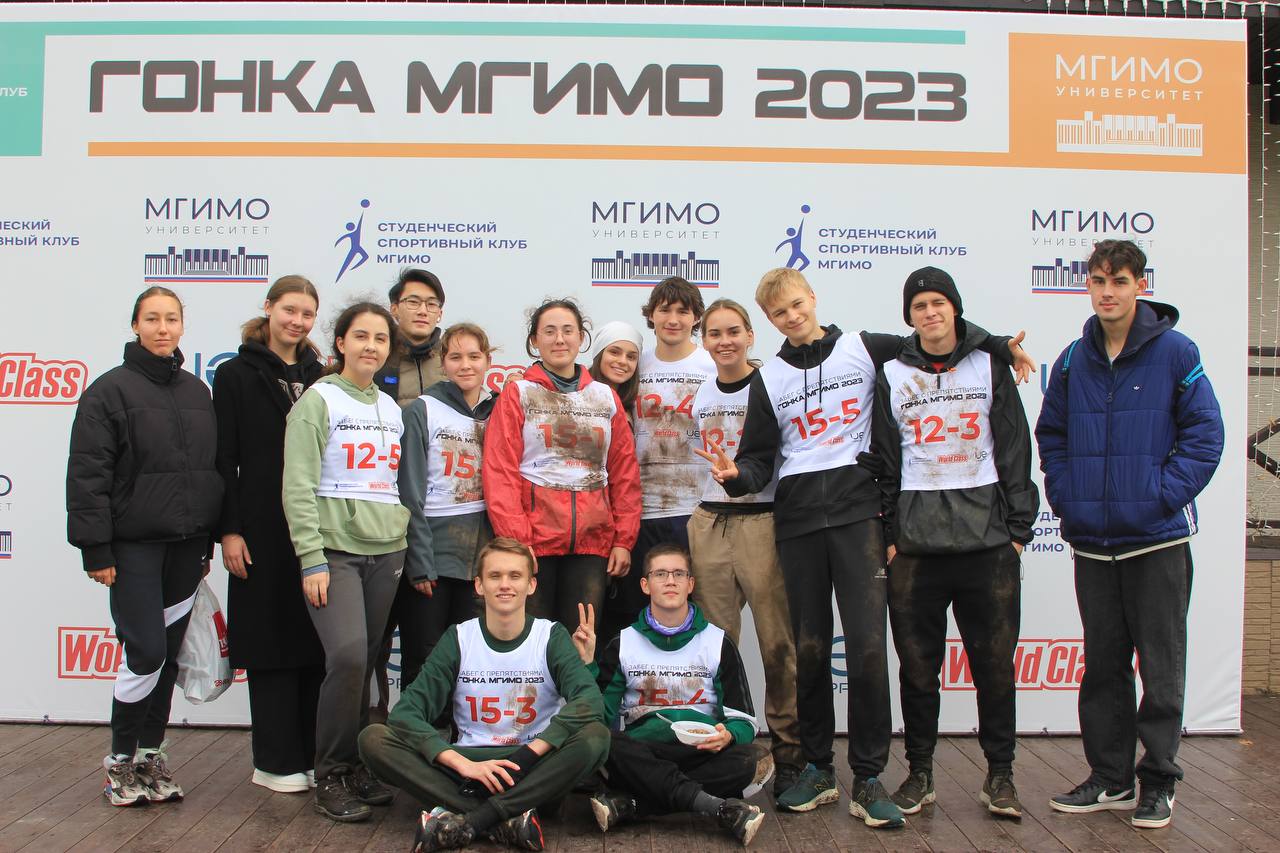
MGIMO Race
October
Moscow Region (Odintsovo)
200 students

MGIMO Cyber Tournament
March
Conference hall
100 students

Series of events devoted to the Victory Day
May
MGIMO Courtyard
300 students

MGIMO Health&Fitness Weekend
April
Moscow Region
100 students

Summer school
Republic of North Ossetia – Alania/Sochi
July
40 students

Institute Day
October 14
Conference hall
1000 participants

“Battle of Faculties”
November
Conference hall
1000 students
MGIMO EXPLORE – GET TO KNOW MGIMO GET TO KNOW RUSSIA

Cultural tours around Moscow

Cultural tours around Russia

«MGIMO Exchange»
An ougoing team-bulding event of intercultural exchange
March
Ethnographic Park “Etnomir” (Kaluga Region)
Dress-code

MGIMO is a university with an elitist tradition, which trains the future political elite of Russia and many other countries. The level of education and the diplomatic status of the University require a specific dress-code to be respected in the University by professors and students alike.
The dress-code may vary depending on the timetable, and some classes may require formal attire. Shorts and flip-flops are prohibited in the University at all times.
On official occasions, for example, at meetings with visiting guests of the University, we recommend you to wear a suit, a shirt or blouse and appropriate footwear.
Do bear in mind that the University has a gym and swimming pool and you will need sportswear and trainers to work out.
Sports clothes are sold at the shop by MGIMO’s swimming pool and in a multitude of shops around Moscow as well.
AROUND MGIMO
MGIMO's surroundings
MGIMO is located in the South-West Administrative District of Moscow. It is one of the greenest and quietest areas in Moscow. There are many universities nearby, including Moscow State University (MGU), People’s Friendship University of Russia (RUDN University), the Russian Presidential Academy of National Economy and Public Administration (RANEPA).
The vicinity of MGIMO has a good infrastructure. By the metro station, there are large shopping centers, convenience stores and cinemas. The Park of the 50th Anniversary of October is within walking distance from the University and in winter has a skating rink.
Post office and pharmacy
POST-OFFICE
The closest post-office to MGIMO is located on Koshtoyantsa Street 33.
The office is open Monday to Friday from 8 a.m. to 8 p.m. and Saturday from 9 a.m. to 6 p.m. It closes for a lunch break from
1 p.m. to 2 p.m.
MGIMO’s postcode is 119454.
A number of international logistics companies operate in Russia such as DHL, FedEx, Pony Express, TNT, UPS, etc.
PHARMACY
The pharmacy nearest to MGIMO is called 36.6. It is also located on Koshtoyantsa Street 33. This drugstore chain has many other outlets in Moscow.
The 24 hour drug-shop called Stolichnaya is located on Prospekt Vernadskogo 62.
There are small pharmacies at the entrance of the supermarkets Victoria and Sedmoy Kontinent (in English “The Seventh Continent”). The cheapest pharmacy is Samson Pharma and its nearest outlet is situated on Leninsky Prospekt 119.
Banks and ATMs
The official currency of Russia is rouble and this has long been no formality. By all means, it cannot be ruled out that, in some antique shop in the Arbat, they will happily accept your dollars or euros. However, generally, you will not be able to buy anything in Moscow with foreign cash.
In the city center there are hundreds of currency exchange kiosks to be found at every turn, bank branches and ATM machines, which are usually located in the outlets of various banks, where you can send and receive money transfers, buy
currency or withdraw cash.
Never approach exchange points that are not affiliated to any bank. They usually offer more appealing rates but also present a greater risk of forgery, so we recommend that you exchange currency only in official banks. VISA and MasterCard cards are accepted virtually everywhere and soon, according to the Moscow authorities, there will be no shop or café where you would not be able to pay by card. Moscow open markets are the places where they accept both cards and cash.
As in many other countries, VAT (value added tax) is applied to almost all payments and purchases on the territory of the Russian Federation. In Russia VAT is 22% and can only be refunded to foreign tourists coming to Russia for short stays.
Cafes and restaurants
There are several sushi bars near MGIMO: Tanuki (Koshtoyantsa Street 1a), Planet Sushi (Udaltsova Street 40a), Asia (Prospekt Vernadskogo 39a).
You can also have a snack in a wide range of cafés at the Zvezdochka shopping centre (Pokryshkina Street 4, nearby Yugo-Zapadnaya metro station). There you will find fast-food restaurants, Planet Sushi, Pancake House, Kroshka-Kartoshka (Russian fast food offering jacket potatoes with various fillings), Mu-Mu, Starbucks coffee, Tea Funny Bubble Tea, Il Patio (an Italian restaurant).
There are also several restaurants, cafés and bars (among them Seasons, Dunkin’ Donuts, The Noodle house, Coffeetun/Sushitun) in Rio Shopping Mall (Leninsky Prospekt 109). There one can visit Teremok – a fast food chain serving dishes of traditional Russian cuisine.
Next to Prospekt Vernandskogo metro station, you can stop for a drink or snack at London Pub, Krujka Pub, Coffee House and Shokoladnitsa (a café with good coffee and snacks).
Tipping is a common practice in Russian cafés, restaurants and other public places and shows that you have enjoyed the service. The average tip is 10% of your bill. Leaving tips, however, is not compulsory. Please, note that no tips are needed on campus.
All the cafés mentioned have stores around Moscow and they offer everything from a drink or snack to a full dinner at an affordable price.
Supermarkets and grocery stores
The nearest supermarket is Sedmoy Kontinent. To reach it from MGIMO cross the road (Lobachevskogo Street), turn left and walk to the first intersection, then turn right and walk along Koshtoyantsa Street up to building 21a.
Most students living on campus prefer to buy food at Victoria supermarket as most food items are cheaper there. Other services are also available there including a drycleaner, a photo shop and a pharmacy.
There is a convenience store Ryabinka across the street from the University, where you can purchase bread, milk, soft drinks, snacks, and other basic items.
One can find everything needed in Perekryostok (a food retail chain) in shopping center Avenue South-West nearby Yugo-Zapadnaya metro station. Perekryostok (in Russian crossroads) is renowned for its own bakery, a huge assortment of
ready-made salads and cooked dishes.
Most supermarkets and shops in Moscow are open from 9 a.m. till 10 p.m., though opening times may vary from one store to another, while some supermarkets work 24/7.
SIGHTSEEING IN MOSCOW
Russia is a country with a very rich and diverse history. Its capital, Moscow, is the historical, cultural, and business center of the country and is home to hundreds of museums, exhibition halls, libraries and cultural sites. Every day a dozen of cultural events take place around the city. We will only mention here its main cultural sites, with which you can begin exploring the capital.
Main sights
The Kremlin is at the heart of the historic district of Moscow. The Kremlin is the largest existing fortress town in the world. It contains palaces, churches and museums, and is the official residence of the Russian President. The Kremlin should come first on your list of sites to visit. Enjoy the phenomenal beauty of the Kremlin cathedrals, the famous Bell Tower of Ivan the Great and the treasures of the Armoury Chamber and the Diamond Treasury. If this is not enough for you, there is Lenin’s Mausoleum in the Read Square. Yes, you can still go in there. Metro stations: Borovitskaya (grey line), Biblioteka Imeni Lenina (red line), Alexandrovsky Sad (light blue line).
The Red Square is the main and most prominent square in Moscow. Its main sights are Saint Basil’s Cathedral, “GUM” the State Department Store, a Historical Museum, Kazan Cathedral and Spasskaya Tower. The nearby Tverskaya Street is the main avenue of Moscow which combines various styles from different epochs: famous Fillipov’s Bakery, Eliseevsky Food Store, Moscow City Hall, a monument to the founder of Moscow Yuri Dolgoruky, the Russian Museum of Modern History, Chekhov Moscow Art Theatre, Ermolov Moscow Drama Theatre. Muscovites like to meet by the monument to the famous Russian poet Alexander Pushkin on Pushkin Square.
Old Arbat Street is a pedestrian street in the historic centre of Moscow. Its appearance and atmosphere speak volumes about Old Moscow. It also has plenty of cafés, restaurants and souvenir shops. New Arbat Street runs in parallel to the Old Arbat Street and has a number of restaurants, shops (including a large bookstore) and a cinema. To reach Old and New Arbat Streets, you can get off the Metro at the stations Arbatskaya or Smolenskaya. Vorobyovy Gory is another place to go, this time to admire from high up the wonderful vista of the Moscow City panorama and enjoy a splendid view of the Moskva River.
THEATRES

Moscow is renowned for its theaters. Dozens of performances are held all over Moscow on weekdays and weekends. The most famous Moscow theatres are:
The Bolshoi Theatre
It is a classic venue for opera and ballet, and other performances, known and admired the world over.
bolshoi.ru
The Maly Theatre
Established in 1806, it has been performing on Teatralnaya Square since 1824 and traces its origins back to the Moscow University drama company, founded in 1756. In the 19th century, it was universally recognized as Russia’s leading dramatic theatre.
maly.ru
The Lenkom Theatre
Founded to house a Merchant’s Club in 1907 and then renamed as Lenkom in the Soviet epoch, it produces theatrical and musical shows. Over its 80-year history, Lenkom has revealed its ability to innovate and stage experimental pieces both during the Soviet period and nowadays.
lenkom.ru
The Vakhtangov Theatre
Founded more than 90 years ago, it stages performances of different genres, ranging from classic tragedies to mischievous vaudevilles. Popular Russian actors perform at this theatre.
vahtangov.ru
The Sovremennik Theatre
It was founded in 1956 by a group of young Soviet actors. The company has created over the years dozens of drama productions, many of which have become iconic.
sovremennik.ru
The Moscow Operetta Theatre
It has been running since 1927 and traditionally stages the classics of light opera. Its repertoire includes the works of Lehar, Strauss, and Kalman, alongside the “Soviet operetta”.
mosoperetta.ru
MUSEUMS
Moscow boasts an impressive array of museums catering for every taste. Some are very large and famous and contain outstanding masterpieces; whereas others are original, erudite or dedicated to a specific field of interest. Making a visit to a museum in Moscow can be fascinating. We will only mention here the most famous ones:
To learn more about Moscow museums, please, visit www.museum.ru.

The Moscow Kremlin Museums
There is a large museum complex in the Moscow Kremlin. The Kremlin museums contain the treasures of the Russian Diamond Fund and a rich collection of Armory. You can check the ticket prices and the museum’s opening hours on www.kreml.ru
The Tretyakov Gallery
Together with the Russian Museum in Saint Petersburg, this is the main collectionof national art. The collection of Pavel Tretyakov, who was a mechant andgifted the collection to Moscow, is packed with masterpieces: from the main Russianicon of all times – the Trinity by Andrey Rublev, to the works of Repin, Vereschagin,Surikov, Vrubel and Serov.
Apart from its static exhibition, the TretyakovGallery always has interesting temporary expositions.
The Pushkin Museum of Fine Arts
Unlike the Tretyakov Gallery, the Pushkin Museum was intended as a western museum demonstrating the world art. The intention indeed materialised, as its collection includes Cranach and Botticelli, Rembrandt and Poussin. However, the main pearl of the museum is its collection of French impressionists and post-impressionists.
arts-museum.ru
The Moscow Museum of Modern Art
This state museum concentrates on the 20th and 21st century art. Its main building is situated in Petrovka Street, but it also has spacious galleries on Tverskoy and Gogolevsky Boulevards.
mmoma.ru
PARKS
Moscow has lots of parks and gardens where you can walk, ride a bike, roller skate or try out nearly every type of sport. In recent years Moscow’s parks have undergone renovations and are now modern and comfortable areas to spend time. Muscovites enjoy going for walks in parks. Here is a list of a few.

The Gorky Park
The Gorky Park is one of the most famous parks in Moscow. Laid out in 1928, it was the first park of its kind, and served as a prototype for hundreds of others across the Soviet Union.
park-gorkogo.com
The Viktory Park
It was only completed in the mid-1990s, but still reflects the Soviet tradition of monumental triumphal art. Located on and around the Poklonnaya Gora – the hill where Napoleon waited in vain to be given the keys to the city when his troops were surrounding Moscow in 1812 – the park is set in an area rich in Russian military history.
poklonnaya-gora.ru
The Main Botanical Garden
The largest and most famous botanical gardens of Moscow and Russia are located in the northwest part of the city. This 360-hectare (890-acre) park was officially founded in 1945.
gbsad.ru
Aptekarsky Ogorod
The Apothecaries’ Garden – Russia’s oldest botanic garden – was founded by Peter the Great in 1706 to grow medicinal plants. This garden is now known as Moscow State University’s Apothecary Garden. This tiny piece of Russia’s natural and cultural heritage is now the most well-groomed, photogenic, accessible, informative and cosy garden in Moscow. The nearest metro station – Prospekt Mira (see brown belt line) – is 200 m from the entrance to the Garden.
hortus.ru
The Park of the 50th Anniversary of October
It is the closest to MGIMO. It stretches out over 60 hectares and contains woods, as well as an ice-rink in winter. The park is usually quiet and rarely crowded. Among the residents in the area, there is a rumor that the park contains an underground city – a bomb shelter.
park50let.ru
The Sokolniki Park
Located not far from the centre of the city, the park received its name from the Sokolnichy Quarter, the 17th century home of the sovereign’s falconers (sokol is the Russian word for falcon). It was created by Tsar Alexei Mikhailovich (father of Peter the Great), a keen hunter who loved to go falconing there.
park.sokolniki.com
Serebryany Bor
Serebryany Bor is a famous pine forest park located in the north west of Moscow. With over 200 forms of plant life, it is also home to a watersports complex, as well as various marinas and stables. Serebryany Bor’s beaches are the cleanest in the city and very popular among Muscovites and tourists to escape from the hustle and bustle of the city.
The Museum-Reserve Tsaritsyno
The Museum-Reserve Tsaritsyno is an ensemble of “Russian gothic style” palaces and gardens. It is famous for its unique fountain complex.
tsaritsyno-museum.ru
The Kuskovo Estate
It is a cultural monument of the 18th century, a preserved counts residence with a unique greenhouse and the Museum of Ceramics.
kuskovo.ru
SPORT IN MOSCOW
Summer sports: roller-skating and cycling
If you enjoy roller skating and/or cycling, below you will find a list of the most famous places where you can have fun.
The Gorky Park
One of the largest outdoor parks in Moscow, where you can rent rollers and bicycles. It also offers the opportunity to play table tennis or volleyball.
park-gorkogo.com
VDNKh (from Russian Exhibition of Achievements of the National Economy)
A big outdoor park where you can also rent rollers and bicycles.
vdnh.ru
Vorobievy Gory
It is the nearest place to MGIMO for roller-skating and cycling (equipment available for rental).
The Izmailovskiy Park
Roller and bicycle rent available every day in summer.
izmailovsky-park.ru
The Fantasy Park
It is an entertainment center which offers different activities such as an aqua park, billiards, bowling, a karaoke. On the 4th floor of Fantasy Park, there is a big indoor roller skating rink for 1,500 people. Skating classes are also available.
fpark.ru
Roll Hall
This is an indoor facility stretching out over 1,500 sq.m. You can roller-skate there, get a drink at the bar, go bowling and play billiards.
rollholl.ru
The average price for renting rollers is 100-300 RUB/hour. Remember that in most places, you must leave some ID document as a pawn.
Alongside the rinks mentioned above, there are many other places you can skate and cycle. You just need to look them up online.
Winter sports: ice-skating and skiing
Ice-skating is very popular in Russia among kids and adults alike. Below you will
find Moscow’s best skating rinks. Almost all parks offering roller skating in summer
turn into ice-rinks in winter.

The Red Square
Ice-skating here at least once is a must if you get to spend a winter in Moscow. This is the major ice rink in Moscow. It is located in the middle of the Red Square and offers a view of the Kremlin and the main Russian New Year tree.
The Gorky Park
This park is really huge and in the winter its pathways are iced-over to enable ice-skating all around it. The park has modern infrastructure and the admittance is free of charge.
park-gorkogo.com
VDNKh (from Russian Exhibition of Achievements of the National Economy)
One of the biggest open air rinks in Europe and the most modern one in Moscow. Opened in the winter of 2014, it has great infrastructure, a café and skates rental.
vdnh.ru
Vorobievy Gory
The closest place to MGIMO which has a slope for snowboarding and skiing.
The Year-Round Ski Resort SNEJKOM
Not only the ski slope, but also the ice rink, entertainment and recreation complex, including a fitness center, aqua-zone, slot machines, laser paintball, are at the service of visitors.
snej.com
The Moscow Alps Ski Complex
The ski complex “Moscow Alps” (KANT) is located at Nagornaya metro station (grey line). It was founded in the 1970s and has been developing rapidly since then. On its slopes eight different lengthways (from 80 to 300 m) are now in operation.
The width of the route is from 25 to 100 m, the height difference to 55 m. At leisure time, in addition to the mountain slope, visitors are also provided with the following services: trampoline complex, sauna, sports and fitness center, cafés and restaurants, oriental martial arts hall, aerobic room, sports goods shops, indoor tennis court.
kant.ru
The Park of the 50th Anniversary of October
There is a skating rink in the park, which is equipped with heated changing-rooms and a café.
OTHER INFORMATION
CUSTOMS AND TRADITIONS
Moscow is a modern secular European city, where no strict rules of public behavior apply. However, Muscovites are somewhat conservative and demonstrating passionately one’s political or religious beliefs or sexual identity in public could be taken by others with disapproval. In Moscow, it is prohibited to consume alcoholic drinks in public. Police are strictly monitoring abuses and no paper packs would pass for a camouflage of a bottle.
Smoking is prohibited near and inside metro stations, schools, hospitals, at stadiums and in any premises, apart from one’s own apartment. Smoking is also prohibited in cafés and restaurants.
Russians have two pronouns to address people: Ты (Ti) and Вы (Vi). In English both of them are translated as “You”. But in Russia it makes a difference which pronoun you use. “Ты” is reserved for a friend or a kid. It is also alright to address an unknown young person with “ты”, e.g., if you are both students. A person who is much older, even if you have never met before, may address you with “ты” – age has its privileges. However, this does not mean you can answer them with “ты”. It is best to start off with “Вы”, especially if you want to be polite and do not know a person. At a later stage, one of you can offer to “shift to ‘ti'” – “перейти на ты”.
Russians dress up to go out more often than foreigners do. Even getting ready to go for a casual walk, a Russian woman may wear high heels and a nice dress, and a man may wear a shirt. Foreigners run the risk of being dressed too informally for the occasion, whatever it may be. So if you are invited to a dinner party, to the theater or a restaurant, even if you think the event is informal, it is a good idea to check up on the dress code required.
Russians just love to entertain guests and are really great hosts. Russians like visiting each other, meeting up with friends for dinner, or just stopping by to catch up on the latest news. The latter is called “to drop in for a cup of coffee”.
It is very uncommon to leave guests without a treat. You will always be offered something to eat or drink when visiting Russians in their homes. It is also considered to be good manners to bring something with you, when you pay a visit to someone.
Russians even have an expression “прийти с пустыми руками” that literally means “to come empty-handed”. You do not have to buy expensive gifts when you are a guest. A box of chocolates or a bottle of fine wine both make adequate gifts. If you are visiting a family with children make sure to bring a treat for the kids: sweets, chocolate or some fruit will do just great. Theme parties are quickly gaining popularity among young Russians. A group of friends may choose to fix a sushi night, a pajama party or meet up for beers.
Russians always take off their outdoor shoes when they get home. The host usually offers a pair of slippers (in Russian tapochki). In some cases, for example if you are invited to a party, you can bring a pair of clean shoes to wear inside.Russian students often bring a change of shoes to university, especially in winter.
Russians do not go Dutch. Here is where Russians differ strikingly from Europeans. So, if you ask a lady out (it does not matter whether it is a date or you just decide to drink coffee while walking around the city) do not expect her to pay for herself, not at a restaurant or anywhere else.
Russians believe that men should help women who are carrying heavy things, as men are stronger than women. If you do not lend a helping hand you will be considered impolite. Sometimes men help even unknown women if they notice they are struggling with weighty bags.
In Russia people offer a seat to the elderly and pregnant women in public transport. Sometimes women, even (or especially) young ones, are offered seats on public transportation. Getting up and offering a seat to the elderly is compulsory. There are special seats for the aged, pregnant women and people with children in public transport, but you still ought to give up your seat if they are standing by you.
Russians like to serve a festive dinner to guests on occasions such as birthdays, the New Year and Easter. These dinners include hot dishes, a selection of cold appetizers and salads, and cake for dessert. Russian housewives prefer to cook everything themselves. Alcohol also has its importance in a holiday dinner. Russians usually put all alcoholic beverages on the table at once so that guests may pick their favorites themselves, rather than bringing out the wine during the main course and the spirits at dessert, for example.
RUSSIAN CUISINE

Russia has its own ideas about how and what to eat. Russian people like to eat home-cooked foods and usually eat three times a day. The three meals of the day in Russia are called zavtrak, obed and uzhin. With the exception of zavtrak (breakfast), there are no exact English translations for these daily meals. For example, the second meal, obed, is served around 2 p.m. and can be called either “lunch” or “dinner” in English. The third meal, uzhin, is served after 6 p.m. and can
be called either “dinner” or “supper”.
It is very common for Russian families to have kasha for breakfast (a type of porridge made from different grains), butterbrots (a sandwich made with a single slice of bread and a topping such as butter, cheese, or ham), hard- or soft-boiled or fried eggs, tvorog (similar to cottage cheese) or cereal for breakfast. Russians drink a lot of tea and coffee.
RUSSIAN SOUVENIRS AND SYMBOLS

One of the most popular symbols of Russia is undoubtedly a traditional Russian matryoshka doll. These finely decorated wooden dolls “with a secret” are often called “babushka dolls” by foreigners, but it is incorrect. Tourists are very fond of taking matryoshkas back home with them after a trip to Russia.
Banya (a Russian type of sauna, a kind of a steam room) is one of the oldest Russian traditions. It remains popular to this day. You can find banyas in large cities and small towns. Usually those Russians who have summer houses (or dacha), also have their own banya there.
A samovar is a device traditionally used to heat and boil water for tea. The name can be loosely translated into English as a “self-boiler or kettle”. Drinking tea is an inalienable part of Russian culture. In modern Russia, samovars are not used to boil water for tea as originally intended. In fact, they are sold in shops for decorative purposes so that some families can use them during holidays as a tribute to ancestors and traditions.
What other souvenirs can you bring back from Russia?
Alongside samovars and matreshkas, Russia is famous for different authentic crafts like gzhel or khokhloma paintings. Tourists also like to bring valenki (winter felt boots) and ushanka (a winter hat). You can find souvenirs shops in touristic parts of Moscow such as Old Arbat Street and the Red Square.
HOLIDAYS
Russian holidays reflect all aspects of Russia’s history, customs and traditions.
Here is a quick list of official public holidays and other Russian festivities.
31st December – New Year, the biggest Russian holiday
7th January – Orthodox Christmas
23rd February – Defender of the Motherland Day
8th March – International Women’s Day
12th April – Cosmonautics Day
1st May – May Day
9th May – Victory Day (it is a holiday that commemorates the victory of the Soviet Union over Nazi Germany in the Great Patriotic War)
12th June – Russia’s Day
4th November – National Unity Day
In addition to national holidays, there are some religious holidays or popular holidays which are celebrated in the whole country but officially are not days off. Unless they fall on weekends, they are working days.
14th January – The Old New Year, or the Orthodox New Year (it is an informal traditional holiday, celebrated as the start of the New Year by the Julian calendar)
25th January – Students’ Day, or Tatiana’s Day (according to the Russian Orthodox Church Saint Tatiana is declared the patron saint of students)
14th February – St. Valentine’s Day
The last week before the Great Lent – Maslenitsa (sometimes referred to in English as Pancake Week)
The Sunday after the Great Lent – Orthodox Easter (also called Paskha, or Resurrection Sunday)